
A Hand-Painted Ceramic Bowl Inspired by the Art of Iznik
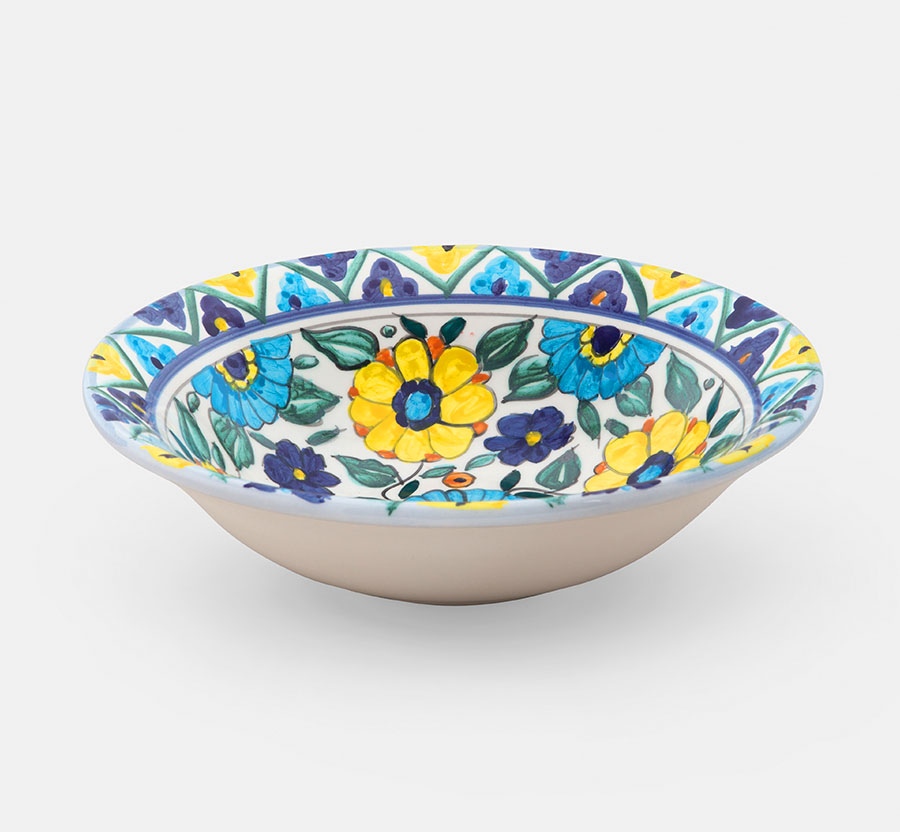
A decorative object becomes more compelling when its beauty carries a story. The hand-painted ceramic bowl from the Benaki Museum Shop does exactly that, translating the visual richness of historic Iznik pottery into an object designed for a contemporary interior.
Created by ceramic artist Elena Lambrou, the bowl draws inspiration from examples of Iznik pottery held in the Benaki Museum's collection. Its detailed painted decoration turns a familiar domestic form into a meeting point between museum heritage, traditional craftsmanship and modern design.
From Museum Collection to Contemporary Object
The bowl belongs to the Benaki Shop's "Inspired by" range, in which objects and artworks from the museum's collections become the starting point for new designs.
This is more than the reproduction of an archival pattern. By interpreting the decorative language of Iznik ceramics by hand, Lambrou brings visible variations and the presence of the maker into the finished piece. The result feels connected to history without functioning as a replica.
Iznik ceramics take their name from the town of İznik—historically Nicaea—in Asia Minor, where pottery workshops began operating toward the end of the 15th century. The tradition became known for refined ceramic forms and elaborate painted decoration.
The Benaki Museum has presented selections from its Iznik holdings and describes its broader Islamic-art collection as extending across regions including Asia Minor, Persia, Mesopotamia, the Middle East, Egypt and North Africa.
Against this context, the bowl works as a small and accessible continuation of a much larger decorative history.
The Character of a Hand-Painted Piece
Hand-painted ceramics have a different presence from objects produced with completely uniform printed decoration. Slight variations in the brushwork give each surface a sense of rhythm and human scale.
That character is particularly well suited to an ornamental bowl. Because the form is broad and open, the painted design can be appreciated as a complete composition rather than as a small detail applied to the side of an object.
With a diameter of 25 centimetres, the ceramic bowl is large enough to command attention on a table, console or display shelf. It can stand independently as a decorative piece, allowing the interior pattern to remain fully visible.
Its scale also makes it easy to combine with books, candlesticks, smaller ceramics or collected objects without allowing the arrangement to feel crowded.
How to Style It
The bowl's historical references do not require a traditionally decorated room. In fact, its intricate surface may have the greatest impact within a restrained contemporary setting.
Place it at the centre of a simple timber dining table, where the warmth of the wood can balance the precision of the painted decoration. On a pale stone console, it can introduce colour and pattern without adding visual weight. A dark shelf or lacquered cabinet would create a more dramatic, gallery-like presentation.
The piece could also be mounted or displayed upright on a suitable stand, allowing it to function almost like a small artwork. This approach is particularly effective in rooms where tabletop space is limited or where the full painted composition deserves to be seen from a distance.
For a layered interior, combine it with objects from different periods rather than attempting to create a strictly historical arrangement. Contemporary glass, minimalist lighting or a sculptural metal object can emphasise the bowl's relevance as a present-day design piece.
Decoration with Cultural Depth
Museum-inspired products are at their strongest when they encourage curiosity about the original works behind them. This bowl does not merely borrow an attractive pattern; it points toward a wider history of ceramic production, trade, collecting and cultural exchange.
Its appeal lies partly in that depth. Viewed from across a room, it is a richly decorated ceramic object. Examined more closely, it becomes an invitation to consider the artistic tradition that informed its design and the museum collection that preserves it.
The relationship between historic reference and contemporary interpretation also makes the bowl suitable for interiors that combine inherited pieces with newer furniture. It can sit naturally beside antiques, modernist design or more informal handmade objects.
A Gift with a Story
The Elena Lambrou ceramic bowl would make a thoughtful gift for someone interested in ceramics, decorative arts, museums or Greek design.
Unlike an anonymous ornamental accessory, it comes with a clear creative and cultural context. The recipient is not simply receiving a bowl but a contemporary interpretation of a historic ceramic tradition represented in one of Greece's leading museum collections.
Purchases from the Benaki Museum Shop also support the museum, adding an institutional dimension to the object's story.
Where Heritage Meets the Contemporary Home
The most successful museum-shop designs are capable of leaving the museum environment and developing an identity of their own. This hand-painted bowl achieves that balance.
Its decorative richness reflects the influence of Iznik pottery, while its clear circular form and versatile scale make it easy to incorporate into a modern home. Displayed on a dining table, a console or a wall, it brings craftsmanship, pattern and cultural memory into an everyday setting.
It is an object intended not only to be owned, but also to be observed.
Product: Ceramic bowl
Artist: Elena Lambrou
Material: Ceramic
Dimensions: 25 cm diameter
Collection: Islamic art; inspired by Iznik pottery
Price shown: €125; €112.50 for members
Shop: View the ceramic bowl at the Benaki Museum Shop